


People in Saigon have always had a special affection for old-fashioned coffee. District 5, District 10, and District 11, home to large Chinese communities, became places where the renowned culinary traditions of China blended naturally into the spirit of Saigon, including its coffee culture.
Back then, there were no coffee filters (phin) for customers to leisurely watch each drop fall into their cups. Instead, finely ground coffee was brewed through a long cloth sock filter and steeped in a medicinal clay pot to extract its full flavor. The first brew was then slowly simmered over a charcoal stove. This explains why, even from two or three houses away, the rich aroma of coffee could still fill the air.
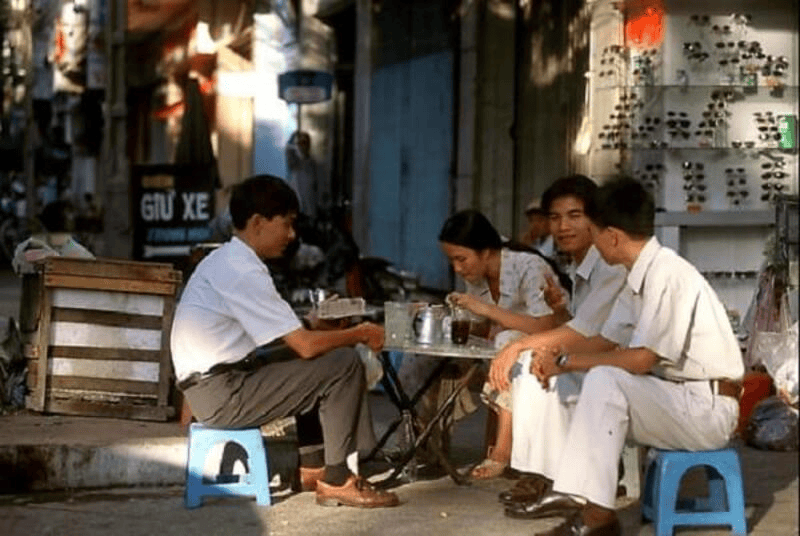
One of the few places that still preserves this traditional brewing method known as "kho" coffee, sock-filter coffee, or "vợt" coffee is located in Chợ Thiếc, Ward 6, District 11. There, Mr. Luu Nhan Thanh has been brewing coffee this way for nearly half a century.
Despite life's many ups and downs, his café has never abandoned its traditional technique. As he puts it, "If the cloth filter wears out, I replace it. If the pot cracks, I buy a new one. But the coffee filter (phin) has been wrapped in plastic and sitting on top of the cupboard for years, I never use it. When drip coffee became popular, I bought one too, brewed with it once or twice, and then never touched it again."

Unlike Mr. Thanh's famous coffee shop, Ba Lu Coffee has quietly spent the last 67 years keeping its roasting furnace alive like a treasured family heirloom. Its old black roasting drum, covered in soot, is heated from below while being manually rotated with a long iron handle.
At first glance, we thought it was a roaster for chestnuts or peanuts. Only when the unmistakable fragrance filled the air did we realize: "Ah, it's coffee."

This unique roasting furnace belongs to the family of Mr. Ba Lu, who once lived on Hai Nam Island, China. Life eventually brought him to Saigon, where he carried with him his own coffee-roasting recipe and built a new life. After his passing, his children continued tending the fire, preserving one of the city's rare surviving traditional roasting methods.
Even then, visitors are not always lucky enough to witness the roasting process. Coffee beans are roasted only twice a month, so only those who happen to visit on the right day can experience the complete journey of how a cup of coffee is created.

Curiously, few people visit "Cà phê bệt" (sidewalk coffee) just for the coffee itself. More often, they come for the irresistible aroma of grilled rice paper topped with crispy fried shallots, or for the endless variety of street snacks sold by roaming vendors.
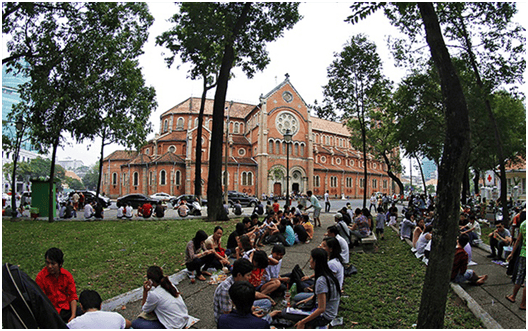
For many years, the lawn area of 30/4 Park, nestled between Independence Palace and Notre-Dame Cathedral in District 1, has been affectionately known by young locals as "the biggest café in Saigon" or "the thousand-star café."
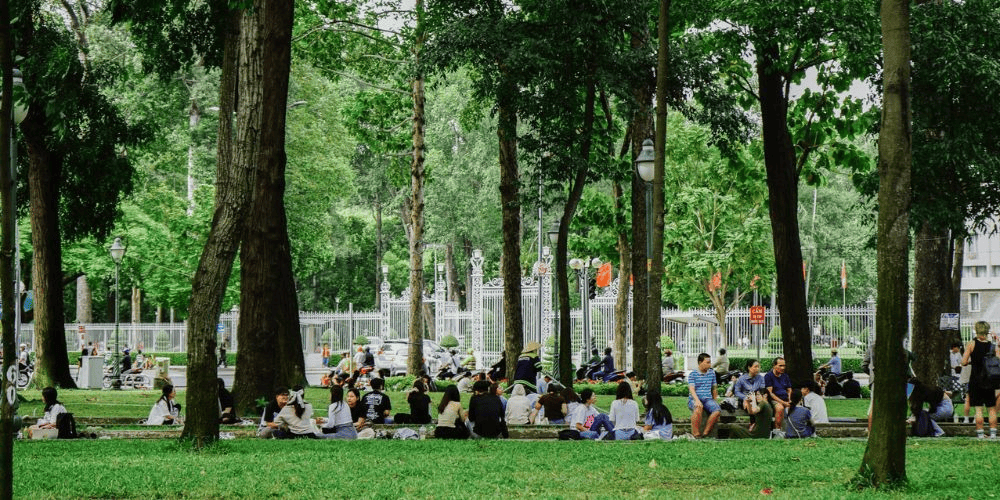
The name '"bệt" simply comes from the way people enjoy their coffee there: sitting directly on the pavement or grass. It has also earned the nickname "students' café", because despite its prime city-center location, drinks remain remarkably affordable only 15,000–20,000 VND with a menu featuring coffee, Vietnamese white coffee, peach tea, lemon tea, fresh orange juice, chilled coconut, soft drinks, and more. The snack selection seems endless as well: stir-fried corn, mixed rice paper, grilled rice paper, fried fish balls, grilled skewers, and countless other local favorites.
The busiest area on weekends is Han Thuyen Street, where groups of young people gather to socialize and practice foreign languages with international visitors. Office workers tend to prefer the quieter area near Notre-Dame Cathedral, perfect for conversations while watching the city lights come alive. Meanwhile, the tree-lined Alexandre de Rhodes Street, with its peaceful atmosphere and little traffic, has become a favorite place for couples.
Every weekend, '"cà phê bệt" reaches its peak season. People of every age can be found there. They come for the cool shade of the trees, the peaceful atmosphere, and the simple pleasure of watching the traffic flow by, but hardly anyone pays attention to whether the coffee is good or bad.
The story of international coffee in Saigon could fill an entire book. Every few weeks, another Western style café appears somewhere in the city's streets and alleyways. Global coffee chains have also flocked to Saigon, making it their promised land.
Yet one café in Thao Dien, District 2, founded by French designer Vincent Demailly, has managed to leave its own unique impression. "I've been in Vietnam for six years, and in Saigon for five and a half," he says. "Vietnam is one of the world's largest coffee exporters, yet many Vietnamese people rarely have the chance to enjoy truly clean, high-quality coffee. That's why I started this project in early 2017."
The first thing that catches the eye is his beautifully designed coffee cart. It features a small bell on the handle, a handcrafted wooden storage box, and distinctly Vietnamese touches such as a thatched roof and wooden sign, all designed by Vincent himself.
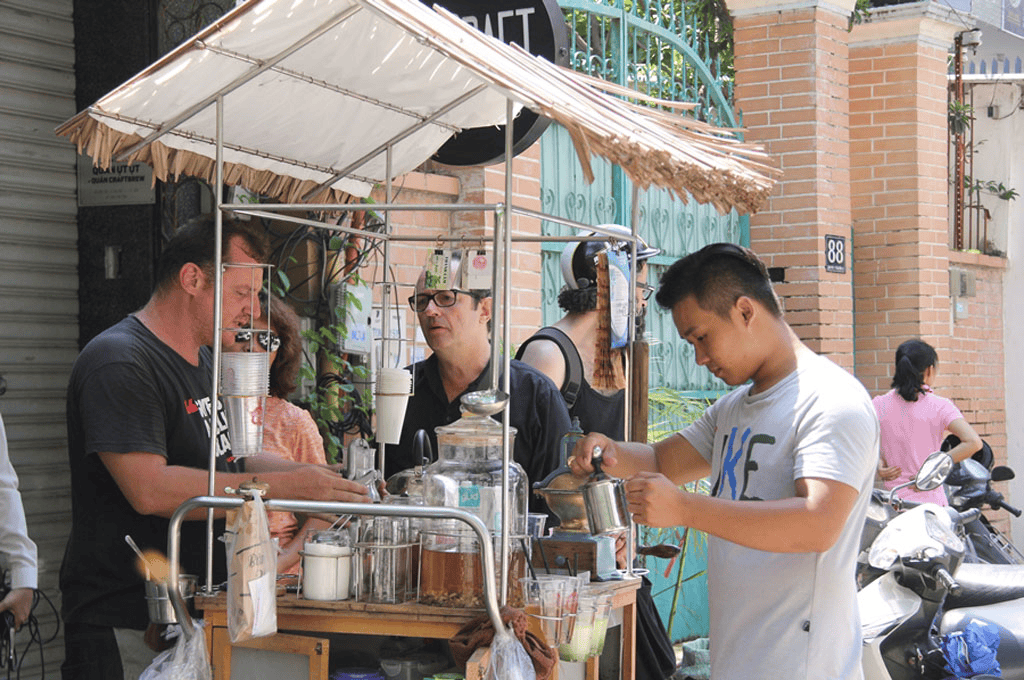
To achieve the quality he wanted, he had a professional espresso machine shipped from overseas. His coffee beans come from Lam Dong and are roasted and used within a single week. According to Vincent, coffee gradually loses its flavor over time and no longer meets the "clean" standard he values.
Working with Vietnamese customers every day has also helped him learn plenty of Vietnamese. His pronunciation of "cà phê sữa đá" (Vietnamese iced milk coffee) is so clear and natural that it often surprises locals. "I love riding my motorbike. Whenever I have free time, I explore the city. I also let my staff run the coffee cart while I personally deliver coffee to customers."

No matter how many drinks arrive from East or West, coffee in Saigon never goes out of style. Some people dislike its sharp bitterness on the tip of the tongue, while others slowly savor the lingering sweetness and aroma that follow, eventually becoming addicted.
If you live in Saigon long enough, you become a Saigonese. In much the same way, when a cup of coffee wins the hearts of the city's discerning drinkers, it simply becomes Saigon coffee.
"Saigon iced milk coffee—always the same, always timeless. Have you tasted it yet?"